Character Creation
Character Creation happens BEFORE LVL 1. During creation, Players finalize their character's Talents, Skills, and Traits (TST) before the Character enters play. This is distinct from LVLing: TST is locked in at creation, while Class Trees and their Abilities are unlocked through character progression (LVL 1 onward).
Character Creation Steps
These steps establish a Character’s identity, alignment, background, race, attributes, starting equipment, and first progression choices before play begins.
- Establish Alignment - Choose your character's moral outlook on the 5-point spectrum (Lawful, Moral, Ambivalent, Amoral, Evil). This is locked in first and is foundational to all subsequent choices.
- Select/Create Background - Choose or create your character's narrative story. Your Background determines your initial Standing with factions and affects cultural equipment access.
- Define Mission Statement - Establish your character's personal mission or purpose. This must adhere to your Background and will tie you to NPCs and factions who have a stake in its success or failure.
- Select Race - Choose your character's race, which determines: size category, base carry capacity, speed, starting age range, Innate Trait Adjustments (bonuses/penalties), Innate Aptitude, Innate Inaptitude, Favored Class Trees, trait bonuses and penalties, and Favored Companions.
- Choose Age - Select your character's age within a 5-year range centered on your race's Starting Age. (All characters Retire after 40 Eons/years of adventuring and may become legendary NPCs.)
- Choose Name and Details - Establish your character's name and personal details.
- Roll and Allocate ATTRs - Roll and distribute your six ATTRs: Artistry, Fortitude, Intellect, Physique, Vigilance, and Wisdom.
- Select TST - Choose Talents, Skills, and Traits using Remnant (REM) PTS. Also select your Aura, which is chosen every Eon (year).
- Store, Equipment and Encumbrance - Select your starting equipment (setting module-based, limited by carry capacity from Step 7's Physique + Race size, limited to Common rank, affected by Background/Alignment/Class/Rank/Prerequisites). Calculate total weight and encumbrance status.
- Starter Standing Notes - Gather any starter Standing notes that can be derived from your Background or Cultural details.
- First Quest and LVL Advancement - Geared up and ready for combat, your character gets their first quest (an easy task). After completing this quest, your character reaches LVL 1.
- Class Tier Selection - At LVL 1, select your Class Tier and repeat Step 8 (TST selection with increased REM PTS and expanded options).
Character Creation in SORC begins, at the table, by establishing a character's alignment and moral outlook. Alignment (Lawful, Moral, Ambivalent, Amoral, or Evil - see Alignment below). Once alignment is locked in, Players select a Background that adheres to that alignment, then select a race, then roll dice to determine points to spend on ATTRs and select TST (Talents, Skills, Traits). After completing the first quest, the Characters reach LVL 1, where they select their Class Tier and repeat their TST selection, a process repeated every time a Character Levels, see ATTR Development on pg. 2. As characters LVL up they'll unlock Main Class Trees and their Abilities. Reaching LVL 1 unlocks Main Class Tier Abilities, LVL 10 unlocks Main Class Path Abilities, and reaching LVL 20 unlocks chosen Path's Branch Abilities.
The character's inventory tracks items without Penalty up to encumbrance limits, and additional character pages allow for tracking personal history, relationships, and achievements. Each character is assigned a Unique ID for online tracking, trading, and achievements.
The character Sheet serves as a central record, displaying key details like background, mission, reputation, and standing, along with customizable elements such as Portraits, armor, and weapons. Customization of a character is also available online, via SORC Web. Open Character Customization
Utilizing SORC Web, Players can save and export their characters as images or printouts, and have options for high-resolution Portraits reflecting their character's identity. Character pages can be customized with images, background info, and logs of ongoing progress, quests, discoveries, and personal notes.
Creation Locks and Changeable Features
Names and Faces are locked in at creation. Body Type is governed by Physique (see Physique) and can be changed according to the Physique rules. Armaments and Companions can be changed after creation.
Character Sheet
The Character Sheet is the central record for the Character's identity, name, race, class, LVL, vital Statistics, current development, and readable status. It connects to the Character Workspace rather than duplicating specialized records.
The Workspace uses one shared characterId across the Character Sheet, Customizer, Property & Cards, Home & Family, and Journal. The Customizer owns presentation and appearance; Property owns possessions, worn or readied Armaments, Companions, and Safe Havens; Home & Family owns Homes, plots, family, and relationships. See Character Sheet & Character Workspace for the complete connection and ownership rules.
Character Details During Creation
This section organizes the identity, appearance, history, and personal records that a Player establishes while creating a Character.
Birth
Player's Name, Nickname, Character Portrait or Photo, Age, Gender and a Character Unique Identification (UID) which is a random 5 unit number combination exclusive to Players that choose to delve into SORC Web's online features.
Age and Growth
Age is the character's numerical age at the start of play. At creation, choose a character's starting age from a range centered on their race's Starting Age, two years below it to two years above it, a five-year spread in total (see each race's entry, below, and the Lifespan, Starting Age, and Retirement Age table, pg. 6). A character must always be portrayed as an adult. Whatever age is chosen becomes the Character's actual Beginning Age going forward. All characters retire after 40 years of adventuring (see Retirement, pg. 5). Characters gain no mechanical advantages from age alone; age is purely narrative and establishes the character's life stage, maturity, and starting point in the story.
Growth is the system where characters establish racial and inherited advantages as they age through play. As characters live years during the campaign, Growth milestones trigger automatically (see Growth and Character Progression, below). Growth is measured separately from mere age: the two scale at different speeds. A character might be 40 years old (their age number) but only at Growth 4 (if the campaign started them already advanced in age). Growth milestones grant increases to Vitality scores (Life, Mana, Stamina, Endurance), Aura points, and Innate Aptitude selections. Some of these changes happen annually, others every five years. Growth is gated by the escalating schedule explained under Character Progression, below, not by the player's choice. See the full Growth table and procedures in the GM Codex, Ch. II, for race-specific details about what changes when.
Birthday
Birthday records place a Character on Essentia’s seasonal calendar and provide the date used for their in-world age and story history.
A character's birthday anchors them to Essentia's seasonal calendar. During character creation, choose a specific date within one of the six seasons. The format is: Season Day, Current Year EA
Modular Rule Set only.
Example: Aut 15, 10,023 EA (Autumn, Day 15 of the current Eon of Adoria)
Each season contains 61 days. Use the season abbreviations: Spr (Spring), Sum (Summer), Aut (Autumn), Win (Winter), Sol (Solstice), Vei (Veil). Days range from 1–61 for each season. See Tomes of Essentia for complete seasonal calendar details.
Character UID
The Character UID is the unique identifier used to distinguish an online Character from others with the same name and connect records to that Character.
Character ID's are RNG numbers provided by our servers and no two ID's are alike, to avoid conflict between online Characters that have the same name and to keep track of acquisitions.
Modular Rule Set only.
Race
Upon creation, characters will choose between 38 races and kinborns from three size categories; Goliath, Standard and Small. See races below.
Alignment
A character's alignment is their ideological and moral orientation, a freely chosen value system that only their Higher Power knows. Your alignment choice directly gates which Main Class Tree Abilities you can learn and which Higher Power you can devote to. It is a foundational decision chosen during character creation before any other class decisions. SORC runs alignment along a five-point spectrum:
- Lawful: bound by tradition, order, and divine authority.
- Moral: virtuous and well-meaning, but personally driven rather than bound to institution or oath.
- Ambivalent: ambivalent to religion entirely, flexible and pragmatic, unconstrained by either pole. Replaces what earlier notes called Neutral.
- Amoral: self-serving and pragmatic, willing to bend ethics without embracing outright malice.
- Evil: driven by ambition, primal instinct, or forbidden magic.
Alignment's Function: the Spectrum The five-point spectrum runs Lawful | Moral | Ambivalent | Amoral | Evil. Every Path holds a base alignment, and its Spectrum is that base plus the alignment on either side of it, three alignments at most. That base carries through all three of the Path's Branches.
A Character learns a Path's or its Branches' Abilities while their alignment sits anywhere in that Path's Spectrum. Devotion to the Path's Higher Power needs the base alignment exactly, and a Character who drifts off it keeps the Abilities and loses the Higher Power bonus until they return.
A Main Class has no base of its own. Its range is whatever its Paths and Branches reach between them, and each class card names that range.
A Witch's Norwitch Path bases at Moral, so a Norwitch may hold Lawful, Moral or Ambivalent. Only a Moral Norwitch draws the Higher Power bonus, and there is no Lawful Higher Power for a Witch to devote to.
| A Main Class's lean | Its Spectrum, who may learn it |
|---|---|
| Lawful | Ambivalent, Moral, Lawful |
| Evil | Ambivalent, Amoral, Evil |
Tier Abilities require the Spectrum. A Character may only learn a Main Class's Tier Abilities while their own alignment sits inside that Class's Spectrum. Every one of that Class's Paths, and every Branch beneath them, falls within the same Spectrum.
Paths and Branches carry their own alignment, and it works on two levels. To learn a Path's or Branch's Abilities, your alignment need only sit inside the Main Class's Spectrum. To draw the Higher Power bonus of that Path and its Branches, you must hold that Path's exact base Alignment, which is the Higher Power's own requirement, not merely somewhere in the permitted range. A Warlock at Ambivalent may learn an Evil Path's Abilities, but takes none of its patron's bonuses until they stand at Evil themselves.
Fall outside a Main Class's Spectrum and you can no longer learn new Abilities from its Tier, its Paths or its Branches, though every Ability already learned remains fully usable. Drift off a Higher Power's exact alignment and its bonuses stop until you return to it (see Fallen and Risen, pg. 3).
A character's current alignment position is tracked on the Alignment bar of their Character Sheet's Progression Tracker. Your choices during play can change your alignment. It is not locked at creation.
Alignment's Sole Purpose: Alignment gates two things only: which Class Tier, Path, and Branch Abilities you can learn (based on Spectrum), and whether you can devote to a Higher Power and hold Standing with its Church (based on exact alignment). Those are its only mechanical gates in the game.
What alignment does not touch. Other beings, NPCs, MAC, and even your own party cannot see your alignment, it is invisible to everyone but your Higher Power. They may scoff at or judge you based on your actions, but every being in Essentia holds the right to follow whatever alignment it chooses. Alignment carries no advantage or disadvantage in Companion Mood or NPC Vendor interactions. Certain guilds and clans, however, do require a particular Spectrum or an exact alignment for entry (a Class or Path gate, not a social one).
How others judge you: Your actions and choices during play generate Praise and Blowback, which build your Reputation and Standing with factions and NPCs. Others use these to form opinions of you, not your alignment. Your Background and Mission Statement are what they see and interact with. Your Alignment remains known only to you and your Higher Power (see Standing & Mission Statement, below).
Player Knowledge vs. Character Knowledge: While all Players at the table know each other's chosen alignments at character creation (to coordinate party composition and narrative), the Characters themselves do not yet know each other's alignments. Each character discovers the moral stance of their companions through roleplay, actions, and choices made during play. This separation allows alignment to remain a dynamic element of interaction and discovery within the game world.
Alignment and Higher Power Mechanics: Once you've devoted to a Higher Power at LVL 4, your alignment determines whether you can hold that devotion and access its bonuses. See Higher Power for the full mechanics of devotion, Falling, and Rising.
Higher Power
Higher Power describes devotion, church membership, alignment requirements, patron benefits, and the consequences of neglecting or leaving a chosen patron.
Every Path is tied to a Higher Power, a divine or otherwise transcendent force. At LVL 4, when a character commits to their first Path, they choose to devote to that Path's Higher Power or remain undevoted. This choice is permanent: devotion is a lifetime commitment that applies across every Class Tree the character invests in thereafter. A second Path taken later in another Class does not grant a second patron; a character holds one Higher Power across all their classes, or remains undevoted in all of them. Upon choosing to devote to a Higher Power, you automatically become a member of that Higher Power's church.
Modular Rule Set only.
Choosing to Devote: A character who devotes to a Higher Power gains access to Abilities from that Path and all three Branches beneath it (if reached). The Higher Power grants a Benefit on Abilities drawn from that Path and any checks made in its service or in its places. However, devotion comes with a cost: the character must practice devotion to the Higher Power's religion or cult and maintain their Standing with the Church.
Church Membership and Devotion Requirements: Upon devotion, you automatically become a member of the Higher Power's church. A devoted character must spend at least one of their daily Endurance actions to honor their Higher Power and its religion. The exact practices vary by patron, but typically involve prayer, ritual, study, or service. Once per week, the character must attend a ceremony or gathering lasting at least one hour, either with other faithful or in private devotion. These are mandatory; neglecting them damages your Standing with the Church.
Standing with Church vs. Alignment: Your Standing with the Church is separate and independent from your Alignment. Standing reflects your devotion actions and whether you practice the required daily and weekly rituals. Your Alignment reflects your ideological values, known only to your Higher Power. You can maintain perfect Standing with the Church through faithful devotion while secretly holding a different alignment, but if the Higher Power detects this misalignment through your actions or choices, it may withdraw bonuses and test you accordingly. Conversely, your Alignment can shift during play due to your behaviors and acts, potentially causing you to Fall from or Rise toward your devoted Higher Power, but this does not automatically damage Standing with the Church, only failure to practice devotion rituals does.
Neglect and Testing: If a character neglects their devotion, failing to spend required Endurance actions or missing weekly ceremonies, they lose Standing with the Church. A neglectful character loses all bonuses from that Higher Power but retains all Abilities already learned. If Alignment shifts away from the exact alignment required by the Higher Power, the character Falls (or Rises for Evil/Amoral paths), losing bonuses but keeping learned Abilities if still within the Spectrum. The Higher Power may test the character through random events, curses, or challenges when alignment drifts or devotion is neglected. A character who returns to proper devotion and alignment may regain the Higher Power's favor, subject to the patron's judgment.
Choosing Not to Devote: A character may refuse to devote to any Higher Power. An undevoted character forfeits all Higher Power bonuses and can never Fall or Rise (see Fallen and Risen Classes, pg. 3), but carries no Drawback and no Path is ever closed to them by a patron. They have complete freedom but sacrifice the power that comes from divine or infernal patronage.
Higher Power Culture. Each patron carries its own observances, its own foes, and its own list of traditions it will not share a Character with. A devoted Character takes on that culture alongside their Race Culture and their Background (see Culture, below).
| Patron | Observance | Will not share a Character with |
|---|---|---|
| Lawful | Oath, record and public rite. Devotion is witnessed and written down. | Evil, and any Path that takes by force what it has not earned. |
| Moral | Service and care. Devotion is spent on other people rather than performed. | Evil and Amoral. |
| Amoral | Bargain and price. Devotion is a contract kept, whatever it was for. | Moral. |
| Evil | Offering and dominion. Devotion is paid in what it costs someone. | Lawful and Moral. |
Ambivalent's Advantage: Ambivalent Paths answer to no god and no patron at all. A character taking an Ambivalent Path gains no bonuses from a Higher Power (there is none to devote to), but also faces no devotion requirements and no risk of the patron's tests. Ambivalent characters are not bound by religion and do not spend Endurance on devotion. This freedom is their trade-off for lacking the patron's blessings.
Forbidden Paths: A Higher Power will not share a character with rival traditions. While devoted, a character cannot learn new Abilities from any Path their patron forbids, whatever their alignment. Abilities already learned remain usable; the forbidden Path simply closes to further picks while the devotion holds. Each patron's forbidden Paths are listed in its own Path entry.
Higher Power Categories: Lawful and Moral Higher Powers are divine or otherwise virtuous, Lawful the more institutional and oath-bound, Moral the more personally-driven. Evil and Amoral Higher Powers are corrupting or self-interested, Evil the more overtly malicious, Amoral the more pragmatic. Only Lawful and Moral Higher Powers carry the risk of Falling; only Amoral and Evil Higher Powers carry the risk of Rising.
Abilities
SORC Abilities are combat-only and come in two forms: Martial Abilities and Spell Abilities. Martial Abilities are physical combat maneuvers and spend Stamina; Spell Abilities are magical combat actions and spend Mana. Both are learned through Main Class Trees and use their card's listed Action cost, Vitality cost, range, effects, and limits.
SORC has 16 distinct Main Classes. Each Main Class contains one Tier - LVL 1 - LVL 3, three Paths from LVL 4 through LVL 20, and three Branches within each Path from LVL 21 through LVL 30.
At each level, 4 slot Abilities are offered as choices; representing various Abilities to choose between: Heals, Damage, Protection, Support and one Hybrid always available as a choice. This process happens at every Class Level of Progression and the midpoint between the next, so two Abilities at each level.
There is no Class selection: a Character learns Abilities from whichever Main Classes they invest in, subject to Alignment Spectrum thresholds and Weapons requirements, which are readied every long rest.
A Character may learn a maximum of 59 Abilities across all Main Classes. The 59-Ability cap allows one invested Main Class to reach its LVL 30 capstone - if you choose to - with a remainder of 29 abilities to be spent in any manner the player chooses until they reach level 30 (beyond level 30 are exemplary levels, granting Vitality and Growth but no Abilities). The 59 Abilities may be distributed across multiple Main Classes in any fashion.
Tier Abilities, Path Abilities, and Branch Abilities retain the Weapon, Armor, Alignment Spectrum, and prerequisite rules printed for their Main Class. Without the proper weapon, you may not use a Main Class's Abilities, and the moment you choose that Ability, you become proficient in all of its Weapon requirements.
Basic ATTKs are separate from Abilities and are governed by Basic ATTKs and Weapon/Hand Proficiency in the Appendix: they may be made with any Weapon the Character can physically wield, but an unproficient Weapon imposes a -5 penalty to Hit; there are no damage bonuses and there is no Ability text.
Each Character must be within a Path's Alignment (Lawful, Moral, Ambivalent, Amoral, or Evil) Spectrum to perform the abilities of its Path and through any of its three Branches. Falling and Rising can be explained in the Alignment section.
Armaments and Ability Progression
Armament Selection Sequence: Armaments are always chosen AFTER committing to the relevant Ability Tree stage - never before. The sequence is fixed:
- At LVL 1 (Tier Abilities): After choosing the Tier Ability slot, select starting Armaments that meet that Ability Tree's Tier requirements.
- At LVL 4 (Path Abilities): After entering the Path progression, select or update Armaments to match the chosen Path.
- At LVL 21 (Branch Abilities): After entering the Branch progression, select or update Armaments to match the chosen Branch.
Your Armaments must meet the Prerequisites set by your currently chosen Tier, Path, or Branch. Changing Tier, Path, or Branch may require you to re-select your Armaments to maintain compatibility with your new Ability set. Armaments determine which weapon-specific Abilities you can activate, so the sequence ensures your equipment always aligns with your current progression.
Basic Info
Character Details are solely role playing Elements and the amount of detail provided here, is entirely up to the Player.
Details
Height, weight and frame, cultural style, crest, tattoos/marks/scars, facial features, eye color, hair color and style, skin tone, and voice tone. Not applicable (N/A) and Unknown (UKN) can be used to fill out any details at the Players' discretion.
Inventory and Value
This is where Characters list the items they have on their person. They can hold as many items as the Player wishes, without a Penalty, as long as the total weight stays within 50% of their carry capacity. See Encumbrance for thresholds and penalties.
Characters may also keep items in their Home or on their land, if they rent or own it. Banks and vaults and storage are also good for safe keeping; However, each home has its own space threshold, see Home and Family Page below. Players can also bury or stash items, and log them into their journals.
Background (BG)
A character's Background (BG) is their back story which has led them to their current status. The Player selects or creates a Background that fits their character concept. Each Background contains narrative and thematic elements that define how the Character views the world and their place in it. Modules provide curated Backgrounds in that module's appendix (further discussed in the GM Codex), visible to the GM and Players alike.
Custom Backgrounds: Players can also create their own custom Background with the GM. The GM must verify that the custom Background fits the character's established concept and narrative. Once a Background is chosen or created and verified, it becomes part of the Character's locked-in foundation and cannot be changed.
Backgrounds answer questions like: Were you a stowaway, runaway, escapee, or sent on a pilgrimage? How did the party find one another? What experiences shaped who you are? What is your Mission Statement (see below)? Characters may create a detailed version of their story in their Journal.
Background sets Culture. A Background carries the Culture a Character was raised into, and any Culture in Essentia may be taken by any race this way. Race sets no limit on it. An Orcus raised Nordian is Nordian, a Dwarf raised among the Omnè is Omnè, and a Human raised among the Fae is Fae, for every cultural purpose (see Culture, below).
Mission Statement
A Mission Statement gives the Character a personal purpose that follows from their Background and creates ties to the NPCs, factions, and conflicts invested in its outcome.
The Mission Statement defines a character's concrete, actionable goals and purpose. It must adhere to the character's Background and be tied to their initial Standing with factions. Mission Statements are not abstract philosophical values or beliefs, they are specific, tangible objectives that the character will actively pursue and accomplish through play. Examples of proper mission statements: "Establish a dwarven trade outpost and defend it" (concrete objective), "Hunt down and destroy the draconic bloodline council" (specific goal), "Locate the legendary Animated Compass Map to control hidden trade routes" (actionable target). The GM must verify that custom mission statements involve concrete, actionable goals aligned with the Character's Background and connected to a faction that matters to their Standing before character creation is finalized.
Modular Rule Set only.
A character's mission statement ties them to factions, NPCs, and their Standing with them. Every Background and mission statement connects a character to other people and organizations in the world. Whether a Player pursues, ignores, or completes their mission statement, that connection carries consequences and rewards, playing out before, during, and after any attempt at completion. Mission progress and changes are recorded in a character's Journal. Mission statements do not need to be completed; they define a character's throughline, not a checklist.
Praise and Blowback on a Mission Statement: A mission statement is watched by NPCs and factions. Some want the Character to accomplish it; others want them to fail. Both are always present, and the Character earns from both at once. Working towards a mission statement draws Praise from those who expect or hope the Character will see it done, and Blowback from those who do not want it done. Neglecting a mission statement reverses this exactly: Blowback from those who expected the Character to act, and Praise from those who are glad they did not. There is no way to sit still and avoid both. Both Praise and Blowback directly affect Standing with factions and NPCs (see Standing & Mission Statement and Standing Tiers, below). See Praise & Blowback under Prestige, below.
When Your Mission Statement Fails: The faction connected to your Mission Statement watches your actions toward it. If your Standing with that faction falls to a breaking point, the faction issues a final chance: repair the Standing or the Mission is abandoned, and you lose access to all benefits and opportunities tied to it. If you fail to restore Standing with that faction after receiving this last chance, your Mission Statement is dead and cannot be revived. You may take a new Mission Statement tied to a different faction at the GM's discretion, but this is a permanent narrative consequence.
Attributes
ATTRs govern raw capability, how physically powerful, resilient, perceptive, charming, animated, and the like a Character is. Traits, covered in the next section below, determine how Characters apply that capability under pressure.
ATTRs begin at 0 by default and cannot have negative scores. Each ATTR score must be at least the highest positive score among the Traits aligned to it, including innate racial adjustments; use the highest value, not their sum. Trait scores may be negative, but negative Traits do not lower an ATTR below 0. For example, Strength -3 and Agility +3 require Physique of at least 3. See Starting ATTR Floor on each race's entry. ATTRs also serve as prerequisites for Armaments, Gear, Items, talents, skills, and Traits.
The six ATTRs; artistry, fortitude, intellect, physique, vigilance, and wisdom. Through their scores, purchased throughout progression, ATTRs determine how strong a character is in a variety of areas, including; Abilities, talents, skills and Traits, referred to as Talents, Skills, and Traits (TST). ATTR SCRs also serve as Prerequisites and more.
The Six Attributes
The six Attributes are the core scores used to describe a Character’s capabilities and to resolve the checks, development, and derived values explained in this section.
Artistry (ART)
Creativity, performance, and articulation expressed through precise dexterity, hand-eye coordination, body fluidity, and craftsmanship; encompassing charisma, tactical deception, and the mastery of fine motor skills. Aligns with Dexterity, Deceit, Charisma, Craftsmanship, and Calibration traits.
Fortitude (FRT)
Physical and mental resilience, resistance to ongoing effects such as poison, disease, bleeding, and damage over time spells, as well as resistance to fear, intimidation, mental control, and elemental damage. Governs Wellness recovery and decline. Aligns with Vigor, Health, Toughness, Constitution, and Willpower traits.
Intellect (INT)
Mental acuity, spellcasting power, reasoning, and resistance to mental effects. Aligns with Wit, Focus, Acuity, Courage, and Warded traits.
Physique (PHY)
Physical strength, speed, agility, and toughness. Aligns with Agility, Strength, Grit, Defense, and Atavism traits.
Vigilance (VIG)
Alertness, watchfulness, and awareness. Aligns with Intuition, Perception, and Focus traits.
Wisdom (WIS)
Knowledge, intuition, and insight. Aligns with Piety and Knowledge traits.
Attribute Development
To develop ATTRs, starting at LVL 0 (character creation) and again at every new Character LVL (LVL), Players roll 1d10 + 1d4 eight times (8 roll totals), discard the two lowest totals, and assign the remaining 6 totals as points to their respective slots in the ATTR Repository. At LVL 0, all results are assigned and locked in; once finalized, the Character advances to LVL 1.
Each kept roll total is between 2 and 14 and is assigned to one ATTR in the Repository. Each ATTR's Remnant (REM) PTS are locked to that ATTR: they can be spent to purchase that ATTR's score at 2 REM PTS per score point, to purchase aligned Talents, Skills, and Traits (TST), or saved as Remnants for that ATTR. No more than 2 ATTR score points may be added to one ATTR per LVL. The main purpose of Remnants is to hold leftover REM PTS that Players did not spend on that ATTR's score or aligned TST.
Before ending the progression process, any REM PTS you haven't spent are saved as Remnants. These Remnants automatically carry forward to the next Character LVL, where you can spend them on more ATTR scores, TST, or special items. REM PTS are never lost, unspent REM PTS always become Remnants and always advance to the next LVL. No REM PTS need to be spent on ATTR SCR; they can be saved as Remnants and later moved into the REM Item Pool for Item Cards. Remnants may also be moved into the REM Item Pool to spend on Item Cards later in the game. Once a REM PTS is spent to purchase an ATTR SCR or TST, it cannot be refunded, it's locked in. There's no turning back.
The REM Item Pool
Remnants sit against the ATTR they were rolled for, and while they stay there they can still be spent on that ATTR's score or its aligned TST. A Player may instead move any unspent Remnant (REM) PTS into the REM Item Pool, a single store held by the Character rather than by any one ATTR.
Moving REM into the Pool is permanent. Once there, those points are no longer bound to the ATTR they came from, and they can never be spent on an ATTR SCR or on TST again. The Pool buys one thing only.
What the Pool buys: SORC Item Cards, of any variant. Standard Item Cards, Special Item Cards, Relics, and the elements used to craft rare items all qualify, and all are generally expensive (see SORC Cards, pg. 4).
What the Pool cannot buy: anything that is not an Item Card. Companion Cards, Armament Cards of either kind, Armor or Weapon, Ability Cards, Encounter Cards, Gear Cards, Lore Cards and Prize Cards are all outside it, whatever the Pool holds.
Concentrating a build. A Player who wants everything in their Physique, Artistry and Vigilance TST can do exactly that, and move their Intellect and Fortitude REM PTS into the Pool to be spent on Items later instead. Nothing is wasted by not spreading evenly. Each Remnant Vendor sets its own prices, and generally these Items are not cheap.
The Pool has no ceiling of its own beyond what a Character can accumulate, and as much as 180 REM PTS can be saved by LVL 30 across Remnants and Pool together. PTS in the Pool carry forward indefinitely, the same as Remnants do.
Where the Pool is spent. Item Cards bought with Pool points come from a Remnant Vendor†, a trader who deals in Remnants rather than Coin and appears only where a module places one. What these Items do, and how strong they are, varies by module: the same card can be a curiosity in one setting and a campaign-turning find in another, so what a Remnant Vendor carries is read off that module rather than assumed.
†An Animated Compass may be used to mark a Remnant Vendor's location as a Safe Haven for a return trip, though how many locations it holds depends on the Compass's own LVL. Refer to Animated Compass, pg. 5.
Attribute Score Range and Improvement
Each ATTR may gain no more than 2 score points per LVL. A character's base ATTR SCR is at least 0 and at least the highest positive aligned Trait score, including innate racial adjustments. Negative Traits do not reduce this floor. Characters improve their ATTRs by spending REM PTS from that ATTR's roll pool, paying 2 REM PTS for each ATTR score point. Characters may choose to spend fewer points than available and save the remaining REM PTS as Remnants.
Saved REMs and Aligned Item Purchases
When a character chooses not to spend all available roll points on ATTR improvements, the unspent points are stored as Saved REMs (Remaining Enhancement Modifiers) for that ATTR. There is no cap on how many REMs a character may accumulate across all ATTRs. However, REMs are exclusively used to purchase items and equipment that are aligned to the ATTR from which they were saved. For example, REMs saved from the Intellect (INT) ATTR pool can only be used to purchase INT-aligned items such as spell scrolls, tomes, wands, or other scholarly equipment. Remnant (REM) items are extremely expensive and represent premium, powerful equipment unavailable through standard gold or barter. Each ATTR pool maintains its own independent REM balance.
Every Character LVL's roll, where each REM PTS went, and the running Remnants total per ATTR run deep enough to warrant their own standalone sheet, separate from the Character Sheet. See the Character Repository below.
ATTR scores have a minimum of 0. Above the starting floor required by innate Traits, characters may not apply more than 2 points of their roll results to any given ATTR at every LVL of progression. No ATTR may exceed a score of 50. For example, at LVL 2, an ATTR SCR may be 0, and may receive up to 4 purchased increases above its starting floor. It must also meet every positive aligned Trait score.
The ATTR cap of 50 is a theoretical maximum, achievable only by dedicating 2 points per LVL to one ATTR for 25 LVLs. Because each ATTR is individually capped at 50 and points are spread across all ATTRs, most characters will have one high ATTR and the rest significantly lower, encouraging specialization. Players should expect most ATTRs to fall between 12-25 unless they deliberately hyper-specialize.
Example, Torv, Barbarian Mountaineer
This example demonstrates how a Player applies the Attribute rules to Torv, including score allocation and the resulting decisions for a Barbarian Mountaineer.
| ATTR | LVL Reached SCR | Max SCR (per LVL cap) |
|---|---|---|
| Intellect | 1 | 2 |
| Artistry | 5 | 10 |
| Fortitude | 10 | 20 |
| Physique | 25 | 50 (cap) |
Torv's Physique reaches its intended stopping point by LVL 25. In the 5 LVLs remaining, he shifts his 2-point-per-LVL allocation to Fortitude instead, gaining up to 10 more score there (2 per LVL x 5 LVLs). At LVL 30, any remaining Remnant (REM) PTS are spent on talents, skills, or Traits (TST).
For a separate, fully completed character built this way from LVL 1 through LVL 30, see Kaida's Character Sheet below.
An ATTR governs how many points you may spend on any one TST aligned to it. Each positive Trait score, including innate racial adjustments, must also remain at or below that ATTR score. Talents and skills follow their own score calculations. Attribute scores cannot be negative.
You may never spend more points into a single aligned TST than that ATTR’s current score. The spending limit is per TST, not shared between them. Trait development must also keep the resulting positive Trait score within its aligned ATTR score. Raise the ATTR before purchasing a Trait increase that would exceed it. An ATTR’s minimum is the highest positive aligned Trait, not the sum of those Traits.
This is what keeps ATTR SCRs meaningful. They set the depth any one TST can reach, while the Character's 199 total sets how much can be spread across all of them.
He spends 3 REM PTS into Strength, his limit, matching Physique 3. Those 3 points double on acquisition, so Strength sits at 6.
He has REM left, so he spends 3 into Agility as well. Also legal, because the limit is per TST and not a shared pool. Agility sits at 6.
He still has REM to spare and wants Strength at 8. He cannot. That would be a fourth point into Strength, and Physique 3 allows three. The only way to deepen Strength is to raise Physique first.
PHY: 3
STR: 6 (3 points spent)
AGI: 6 (3 points spent)
Both Traits stand at double his Physique, and that is correct. The 3 is what he was allowed to spend; the 6 is what he has. At the table Darro grapples and rolls D100: 55 + STR 6 = 61, adding 6, not 3. The ATTR never touches the roll, it only governed how deep he was allowed to buy.
Darro could hold a hundred Remnants unspent and still be stuck at Strength 6 until Physique climbs. Breadth is cheap; depth costs ATTR.
The chart below shows one character's Repository, the six kept results taken at creation and how each was allocated. Progression is always 1d10 + 1d4.
Each score for an ATTR costs 2 REM PTS with a score cap of 2 per LVL. Each TST, aligned to the ATTR, costs 1 REM PTS (Novice LVL). One example of a Trait alignment to an ATTR is the Trait Agility, which is aligned to the ATTR Physique.
| ATTR | 1d10 + 1d4 Roll | ATTR SCR Bought | REM Spent on SCR | REM Spent on TST | Remnants |
|---|---|---|---|---|---|
| Artistry (ART) | 8 | 1 | 2 | 1 | 5 |
| Fortitude (FRT) | 6 | 2 | 4 | 0 | 2 |
| Intellect (INT) | 2 | 0 | 0 | 0 | 2 |
| Physique (PHY) | 9 | 2 | 4 | 1 | 4 |
| Vigilance (VIG) | 2 | 0 | 0 | 0 | 2 |
| Wisdom (WIS) | 7 | 0 | 0 | 0 | 7 |
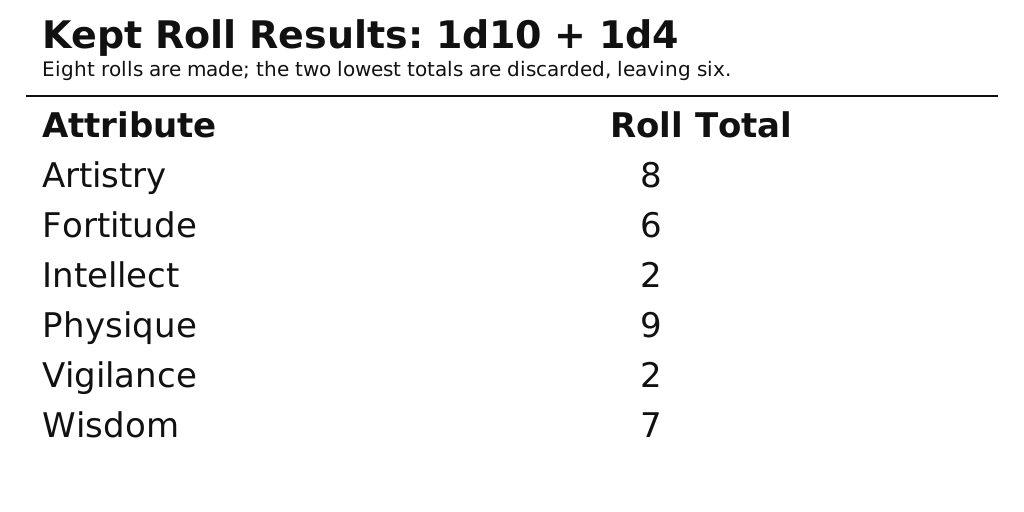
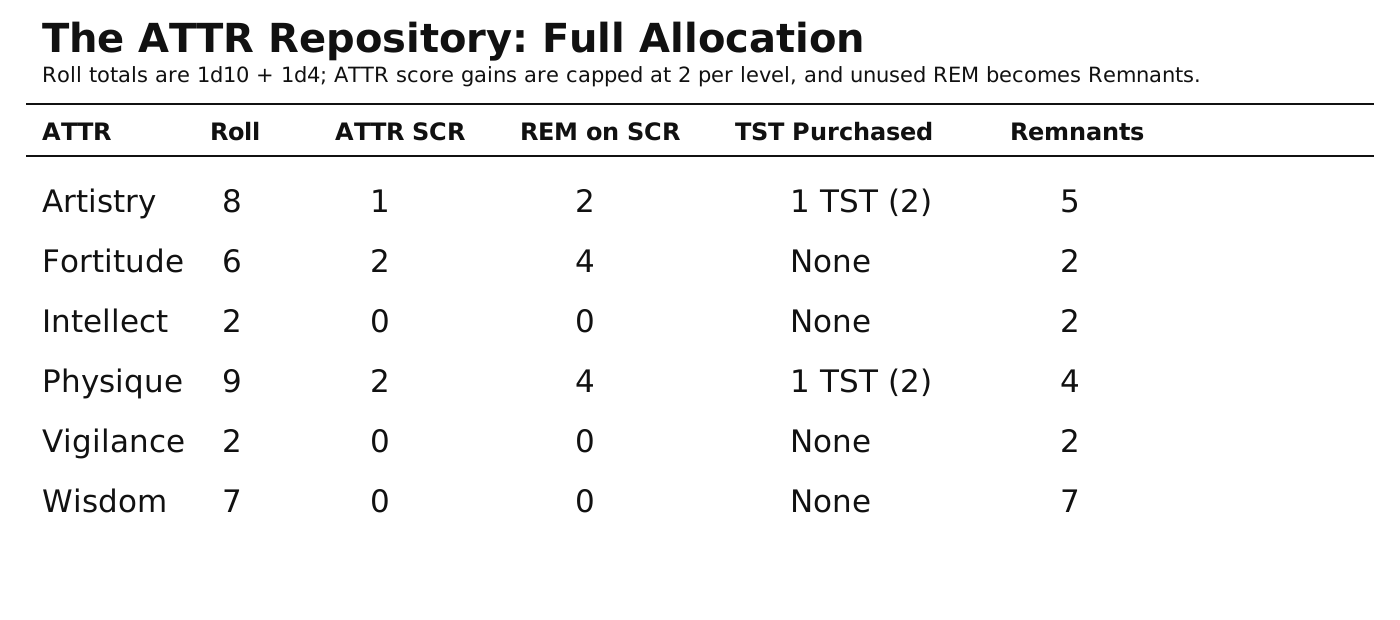
Looking at the chart, examine Artistry first. The character assigned a roll of 8 to Artistry, purchased an ATTR score of 1 for 2 REM PTS, spent 1 REM PT on one aligned TST (giving that TST a score of 2), and saved the remaining 5 REM PTS as Remnants. 2 + 1 + 5 = 8.
Let's examine Fortitude next. The character assigned a roll of 6 and purchased the maximum 2 ATTR score points allowed for the LVL, costing 4 REM PTS. The remaining 2 REM PTS become Fortitude Remnants. The character can use the score of 2 as a prerequisite and modifier during adventures.
Intellect and Vigilance were each results of 2 and were placed entirely as Remnants. Physique received a roll of 9, purchased 2 ATTR score points for 4 REM PTS, spent 1 REM PT on one aligned TST, and saved 4 REM PTS. Wisdom's roll of 7 was placed entirely as Wisdom Remnants.
Players first need a score of 1 in any ATTR before purchasing any TST aligned to it, because 1 is the †default Prerequisite for purchasing TST and one point spent is the smallest purchase there is. The default price for any TST is 1 REM PTS (Novice LVL). PTS spent into a single aligned TST can never exceed that ATTR's score, so at ATTR 1 each aligned TST can receive at most 1 point. Any resulting positive Trait score must also remain at or below its aligned ATTR score; raise that ATTR before developing a Trait beyond it. There isn't a maximum of TST types though, so with enough REM PTS (Remnants), a character could hold any number of TST at that single point each.
Players have the freedom to allocate REM PTS according to their preferences. These REM PTS can enhance athletic or cognitive talents, attack and Protection Abilities such as evasion, Traits like strength and agility, allowing for a customized character build.
Notes to the Game Master, Using Attribute Scores
GMs are provided with detailed guidelines within campaign modules but may also use ATTR SCR at their discretion, for example, when adventures go off-script, or when applying homebrew rules or Unique story elements.
Talents
Talents are ACTIVE special maneuvers. Unlike Traits, which work passively at all times, Talents require deliberate character activation and choice during gameplay. Talents are learned from Talent Trees through Expertise. When a character actively uses a Talent, they make a check against a Difficulty Score (DIFS), and any aligned Trait score is added at its listed value. For example, a Thief using Lockpicking must actively choose to attempt the maneuver, and their Dexterity Trait score is added to that check. Talent scores do not strengthen Trait scores.
Talents are specialized actions that characters acquire from their chosen Talent Trees. These actions come into play when characters encounter interactive challenges in the game world. A Scout may carve a branch into a tool or guide the party along a safer route. An Olympiad might leap across a chasm. A Hacker could manipulate security systems or decipher complex codes. A Thief might pick locks or stealthily pocket items with precision.
Talent Resolution
Using a talent requires an active choice and a d100 check against a Difficulty Score (DIFS) set by the GM. A character rolls d100, adds their talent score plus any aligned Trait score, and compares the total to the DIFS. TST scores are already doubled when acquired, so nothing is multiplied at the table.
d100 + Talent SCR + Trait SCR ≥ DIFS = Success
Talent SCR Multiplier: In the d100 system, talent scores are doubled at the moment they are acquired, not at each use. A point invested becomes 2 score, three become 6, and the number written on the sheet is the number added to the roll. This scaling ensures that talent investment is meaningful in the d100 percentile system where rolls range from 1-100.
Prerequisites: To use a talent, you must have a score of at least 1 in that talent. You must also have access to any specialized gear or kit required by that talent (e.g., a Thief requires lockpicks for Lockpicking, an Olympiad requires a Pole for Vault).
Difficulty by Challenge Type: The GM sets the DIFS based on the difficulty of the challenge:
- Easy: DIFS 20-30 (routine tasks, minimal risk)
- Moderate: DIFS 40-50 (typical challenges, requires skill)
- Hard: DIFS 60-70 (dangerous tasks, demands mastery)
- Near-Impossible: DIFS 80+ (extreme difficulty, veteran-LVL only)
Success Outcomes: On a successful check, the Character accomplishes the intended action. A critical success (96-100 roll) may grant an additional benefit as determined by the GM (e.g., completing the task faster, gaining extra information, or impressing an observer). On a failure, the Character fails to accomplish the task and may face consequences determined by the GM (e.g., time wasted, danger incurred, or a broken tool).
A Talent Tree is a themed bundle of special maneuvers a character can learn. The tree itself is not something a character has; it is a container, and characters learn specific Talents from within it through the tree's Expertise. The Scout Tree holds maneuvers such as Track, Forage, and Guardian's Watch. The Olympiad Tree holds maneuvers such as Leap, Acrobatics, Sprint, and Lift. A character does not learn Scout or Olympiad as a whole; they learn the individual Talents inside, one at a time, through the Expertise they unlock. Some Talent Trees grant specialized gear that a character must carry to use a maneuver effectively.
To access a talent from a Talent Tree, characters must first familiarize themselves with that tree. Players purchase Talents during Character Creation, and at every LVL of Progression thereafter. After that, they can be upgraded with each LVL gained. Talent scores are capped at 100. Remnant (REM) PTS spent on talent scores cannot exceed the score of the aligned ATTR (see ATTR Development, above).
Opening a tree and raising a talent inside it are two separate purchases. REM PTS first open the tree's current Expertise, unlocking every talent available at that Expertise for purchase; further REM PTS then raise the score of whichever individual talents a character actually wants, one at a time. Opening an Expertise doesn't hand over everything inside it, an Olympiad who opens Novice but only ever raises Sprint still has Leap, Acrobatics, and Lift sitting at 0, purchasable, not owned.
Additional Talent Trees are released with each module and its expansions. Browse all available Talent Trees or see pg. 7 for a list.
Talents are accessed through Expertise, see Expertise below.
Talent Hierarchy Structure
Talents are organized into three hierarchical LVLs to provide clarity and organization:
- I. Talent Tree: The highest LVL of a talent category (e.g., Hunter, Scout, Olympiad). Represents the overarching theme and specialization a character chooses to develop.
- 1. Talent: A special maneuver within a Talent Tree (e.g., Tracking, Beast Senses, Leap). Talents are individual maneuvers a character learns through the tree's Expertise.
- a. Practice: Specific variations, techniques, or enhancements within a Talent (e.g., specialized methods, tactical applications, or enhanced versions). Practices provide granular detail to how a talent is executed and mastered.
Example Structure:
1. Beast Senses
a. TBA
b. TBA
c. TBA
d. TBA
e. TBA
Skills
Skills are crafting disciplines learned from Profession Trees through Expertise. Each Profession Tree provides access to a unique set of Skills for work such as forging weapons, preparing meals, crafting remedies, and producing other goods. Skills define a character's professional role and craftsmanship; they are not combat Abilities.
Professions are unlocked by initially investing 2 Remnant (REM) PTS, enabling REM PTS allocation to skills during creation and progression. Skill scores are capped at 100. Skills progress through expertise LVLs (Apprentice, Journeyman, Expert, Artisan, Master, Grandmaster), each requiring aptitude points. Success with skills relies on Experience (XP), appropriate tools, recipes, materials, and often a workshop.
Additional professions are released with each module and its expansions. Browse all available professions or see pg. 7 for a list.
Skills are accessed through expertise LVLs, see Expertise Levels below.
Profession Hierarchy Structure
Professions are organized into three hierarchical LVLs to provide clarity and organization:
- I. Profession Tree: The highest LVL of a profession category (e.g., Blacksmith, Cook, Hunter). Represents the overarching crafting or work specialization a character chooses.
- 1. Skill: A specialized capability within a Profession Tree (e.g., Armorsmith, Butchery, Tracking). Skills are directly tied to the profession and represent distinct areas of expertise.
- a. Skillset: Specific abilities, techniques, or traits within a Skill (e.g., various techniques, bonuses, or specialized methods). Skillsets provide granular detail to how a skill is executed and mastered.
Example Structure:
1. Armorsmith
a. TBA
b. TBA
c. TBA
d. TBA
Profession/Skill Resolution
Using a skill requires an active choice and a d100 check against a Difficulty Score (DIFS) set by the GM. A character rolls d100, adds their skill score plus any aligned ATTR modifier, and compares the total to the DIFS. The specific ATTR used depends on the skill-for example, a Blacksmith check might use Strength or Intellect, a Jeweler check uses Artistry or Intellect, and an Herbalist check uses Wisdom or Vigilance. The skill card or GM determines which ATTR applies.
d100 + Skill SCR + Aligned ATTR Modifier vs. DIFS
Example: Blacksmith with Craftsmanship 4 and Strength 18 rolls d100 + 20 + 18 vs DIFS 60 to forge a sword.
Skill SCR Multiplier: Like talents, skill scores are doubled at the moment they are acquired, not at each use. The number written on the sheet is the number added to the roll. This ensures professions provide meaningful and scaled bonuses in the d100 system.
Prerequisites: To use a skill, you must have a score of at least 1 in that skill. You must also have access to the required tools, workspace, and materials appropriate to that skill. For example, a Blacksmith requires a forge and metal, a Cook requires a kitchen or campfire and ingredients, and a Jeweler requires a workspace and gems. Without these resources, the skill check cannot be attempted.
Expertise Levels and Skill Advancement: Skills progress through expertise LVLs (Novice, Apprentice, Journeyman, Master, Grandmaster). Opening an expertise LVL unlocks access to that LVL's skills for purchase. Your skill score can never exceed your aligned ATTR score. As you advance LVLs, you unlock more specialized and complex skills, allowing you to craft higher-rarity items and perform more advanced techniques. The expertise LVL required for an item or technique is listed on its recipe or skill card.
Difficulty by Rarity/Complexity: The GM may use the following as a baseline, or adjust based on complexity:
- Common: DIFS 40-50 (straightforward, well-understood designs)
- Uncommon: DIFS 55-65 (moderately complex, requires precision)
- Rare: DIFS 70-80 (intricate, demands mastery)
- Unique and above: DIFS 85+ (exceptional, near-legendary difficulty)
Success vs. Failure: Compare your total roll to the DIFS. If your roll meets or exceeds the DIFS, you succeed. If you roll below the DIFS, you fail.
Success Outcomes: On a successful check, the Character creates the intended item. The quality matches the rarity tier if the check was within normal success range. A critical success (96-100 roll) may grant a bonus property, improved quality tier, or faster crafting time. On a failure, the Character wastes materials and time, or creates a flawed version (determined by the GM). The resources spent are still consumed.
Resources Required: Crafting requires appropriate tools, a workspace (workshop, forge, etc.), materials, and time. All three must be available, missing any prevents the craft attempt. The time required varies by item complexity and is noted on each skill card or recipe.
Material Cost: The cost of materials is separate from the Character's gold, materials are consumed during crafting. A failed craft consumes the materials but produces nothing of value. A successful craft consumes materials and produces the finished item.
Action Time & Combat: All Profession work requires actions and takes time, and Profession work can never be performed during combat, no exceptions. A Profession's action time can be decreased with Expertise: as a character's Expertise advances, the same work takes less time. This is one of the defining advantages a Profession holds over a Hobby, whose action time can never be decreased (see Hobbies vs. Professions, below).
Endurance and Crafting: Crafting is not combat and does not consume Stamina or Mana per turn. However, extended crafting sessions consume Endurance based on duration and physical intensity. Light crafting (jewelry, enchanting) may consume 1 Endurance per hour. Intensive crafting (blacksmithing, armor-making) may consume 2-3 Endurance per hour. The GM determines consumption based on the task. A character cannot engage in crafting if they lack sufficient Endurance for the planned duration.
Expertise (Talents & Skills)
Talents and skills are organized into Expertise. Characters have access to the Novice Expertise by default at no cost. To access higher Expertise, Players must first spend Remnant (REM) PTS to open that Expertise. Expertise must be unlocked in order, Players cannot skip ahead. Critically, the points spent into any one talent or skill can never exceed its aligned ATTR score, though the resulting score may stand above it (see ATTRs and TST spending, above). This limitation persists across all Expertise LVLs and throughout your entire character progression.
| Expertise | Open Cost | Per Talent/Skill |
|---|---|---|
| Novice | - | 1 REM |
| Apprentice | 1 REM | 2 REM |
| Journeyman | 1 REM | 3 REM |
| Master | 1 REM | 4 REM |
| Grandmaster | 1 REM | 5 REM |
†What Agility costs per point depends on its Expertise LVL, not on Physique, 1 REM at Novice rising to 5 at Grandmaster. Price and limit are separate: Expertise sets what a point costs, the ATTR sets how many you may buy.
Expertise Cap
A Character may hold no more than 199 TST score in total, counted across every Talent, Skill, and Trait they own. The individual cap is 100. Those two numbers together mean exactly one TST can ever be taken to its cap: max one at 100 and 99 remains for everything else. This encourages diversity rather than stacking everything into a single entry.
Advancing to the Next Expertise
To unlock the next expertise LVL, the total accumulated score across all talents and skills in the current expertise LVL must meet the advancement threshold.
| Advance From | SCR Threshold |
|---|---|
| Novice → Apprentice | 10 |
| Apprentice → Journeyman | 25 |
| Journeyman → Master | 45 |
| Master → Grandmaster | 80 |
Example, Advancing Through Novice Expertise (Olympiad Talent Tree, PHY Aligned)
LVL 1: The character rolls a total of 7 (1d10 + 1d4) and assigns it to their Physique (PHY) slot. They spend 2 Remnant (REM) PTS on PHY(1) and 1 REM PT on a Novice talent, saving 4 Remnants. Novice Expertise access is free.
LVL 2: Another roll of 8 assigned to PHY. Combined with the 4 saved Remnants, they have 12 REM PTS. They spend 2 REM PTS on PHY(2) and 1 REM PTS on another Novice talent (score 1), saving 9 Remnants. Novice Expertise total score: 2.
LVL 3: Roll of 9 assigned to PHY plus 9 saved Remnants gives 18 REM PTS. They spend 2 REM PTS on PHY(3), raise Novice talents using 1 REM PTS each (bringing Novice Expertise to score 9), and save remaining Remnants. Novice Expertise total score: 9.
LVL 4: Roll of 6 assigned to PHY gives 6 REM PTS plus saved Remnants (14 total). They spend 2 REM PTS on PHY(4) and continue raising Novice talents to reach the Apprentice threshold of 10. Once Apprentice Expertise is accessible, they spend 1 REM PTS to open it. Note: Apprentice talent/skill costs 2 REM each (up from Novice's 1 REM), encouraging characters to save Remnants before advancing.
Note: Grandmaster is near end-game for expertise. Refer to GM Codex for expanded expertise rules, full Talent Trees, and Profession skill lists.
Traits
Note: Apex increases Vitality capacity, to whichever resource(s) it's allocated to, Spirit governs recovery rate. Both are their own Vitality scores, not Traits or Vitality resources themselves. See Vitality, below.
Traits vs. Talents: Passive vs. Active
Critical Distinction: Traits and Talents operate on fundamentally different mechanics:
- Traits are PASSIVE. They never require activation. A Trait score is added at its listed value whenever a roll uses that Trait, whether the Character initiates the action or is the target of an action. Traits also feed passive formulas such as Protection Score, Vitality regeneration, and Wellness where the individual Trait rule says so.
- Talents are ACTIVE special maneuvers. They are learned from Talent Trees through Expertise and require deliberate character use. A Thief using a Talent to open a secured container chooses that maneuver and rolls against the relevant difficulty; any aligned Trait score is added at its listed value.
Trait-Talent Stacking
Trait SCRs Stack WITH Talents (When Talents Are Used): When a character actively uses a talent, aligned Trait scores add as a bonus to that talent check. For example, a Thief with Lockpicking (talent) rolls a d100 + Lockpicking score + Dexterity (trait) when actively attempting to pick a lock. The Dexterity trait score augments the talent check in this moment of active use.
Trait scores remain independent: Aligned Trait scores add to an actively used Talent check. Talent scores do not change Trait scores during active or passive use. A character's Trait scores remain independent of the number, score, or use of their Talents.
Introduction to Traits: In the world of Essentia, Traits are passive qualities that shape how Characters navigate challenges, resist damage, and act in combat. A Trait does not become an action when it contributes to a roll; its score is added at its listed value when the Character initiates an action and when the Character is the target of an action.
Traits are closely aligned with Abilities, Talents, and Skills that are associated with the same ATTR. For example, Traits linked to physique will influence combat Abilities and Talents related to physical strength and agility, while Traits associated with intellect will impact mental Skills and resistance. This alignment ensures that a character's Expertise in Talents and Skills, and their combat Abilities, are supported by their Traits and the corresponding ATTRs.
Each Trait embodies a particular aspect of a character's capabilities, both in resisting harm and in gaining offensive advantages. These Traits reflect core qualities that influence both defensive resilience and offensive potential, often working in tandem with Abilities, Talents, and Skills aligned with the same ATTR.
Each Trait operates on its own mechanics. Traits add their listed score to aligned rolls, including Basic Hits, Talents, and Skills, and to other probability-based outcomes like loot where the individual Trait rule calls for it. The same score applies whether the Character initiates the roll or is the target of an action. Agility adds to martial ranged hit and crit, PROTS, Initiative and other movement factors. Strength drives melee attack rolls, damage, grapple checks, and carry capacity, and its score is added as a bonus to melee Critical Hits. Dexterity triggers on intricate and tedious tasks such as mechanical trap avoidance and disassembly, guile checks, and quick strikes with offhand martial weapons, with physical fluidity assisting sneaks, fall damage, and off balance or falling penalty absorption. Willpower resists mind effects. Acuity drives spell attack rolls and damage, and its score is added as a bonus to spell Critical Hits. Charisma rolls against a DIFS in social interactions. Defense requires qualifying Armaments and adds to PROTS against the attacker's attack type with all modifiers. Health governs Wellness's tick rate instead of a d100 roll. Craftsmanship drives Crafting Resolution checks. Each functions independently. Some Traits stack with others...
Mechanics
Traits serve primarily as passive modifiers to d100 rolls, adding their score at its listed value to attack rolls, defense rolls, Skill checks, and any other d100 action aligned to that Trait. When the Character initiates an action, the relevant Trait score is added to the initiating roll. When the Character is subjected to damage, an effect, or another combat action, the relevant Trait score is added to the defensive roll or applicable Protection Score (PROTS). The Player rolls d100 plus the Trait score when a Trait Check is called for and compares the total to the Difficulty Score (DIFS).
Trait Checks require no action and no Stamina cost. They apply automatically when the GM calls for them; the Trait score is added once at its listed value, never multiplied. Defensive Traits add directly to the applicable PROTS calculation, with Resistance defending against Spell-sourced attacks, Defense against martial or Nature-sourced attacks, and Agility against ranged attacks. All applicable defensive Traits stack together to form the Character's total PROTS. Trait scores can be negative, particularly from racial starting values, an Ogre begins at -5 Wit, for example. Innate negative Traits can still be improved through development, but the deficit must be overcome first, reaching +1 Wit from -5 requires a Wit score of 6. Some defensive Traits, such as Parry, also require qualifying equipment to activate.
Traits may be interchangeable between one another for certain tasks, for instance Strength and Toughness may both aid a Character in holding a rope against a falling weight, or Wit and Intuition may aid a character in finding their way out of a maze or windy labyrinths. This runs on every Trait Check in the book, not a fixed pairing or a short list of exceptions: whichever Trait actually matches how the Player describes their approach is the one that rolls, and the GM decides that in the moment, case by case. A trapped door could run on Dexterity (picking it) or Strength (forcing it), talking down a hostile crowd could run on Charisma (winning them over) or Courage (standing your ground until they back off), spotting a forgery could run on Wit, Intuition, or Knowledge depending on what specifically tips the Character off. There's no master list of which Traits are allowed to swap for which, any Trait is a candidate the moment a Player's description genuinely earns it.
Whether a Trait Check is asserting something or resisting something, it uses the same mechanic: d100 + Trait score vs. DIFS, aimed in the relevant direction. Some Traits feed a formula or another roll rather than resolving a Check of their own: Defense adds to PROTS, and Constitution, Focus, and Health are passive inputs. None of this stops a Trait from contributing to a separate attack roll, damage roll, or Critical Hit bonus; the same listed Trait score is used wherever that Trait applies.
Traits also stack with Talents and Skills whenever the theme genuinely lines up, adding their score as a bonus on top of that Talent or Skill's own roll, at the GM's discretion. Strength can aid a heavy-craft Skill Check, Agility can aid an athletic Talent like sprinting or jumping, Dexterity can aid a Thief Talent like slipping a lock or a tail, Acuity can aid an Apothecary or alchemical Skill Check, and so on. This isn't a fixed list either, any Trait can stack with any Talent or Skill the fiction genuinely supports.
- Success: The character resists the effect or enhances their attack.
- Failure: The effect or damage proceeds normally, or the offensive benefit is not gained.
Trait scores may be negative. A positive Trait score, including innate racial adjustments, cannot exceed its aligned ATTR SCR. Each Attribute score is 0 or higher and must equal or exceed its highest positive aligned Trait; negative Traits do not reduce that minimum. A character must have at least a score of 1 in an ATTR before purchasing aligned TST (default cost: 1 Remnant (REM) PTS each for Novice LVL traits).
To the reader: Think of ATTRs as building blocks and Traits as the passive qualities that modify what the Character can do with those blocks.
-
Agility
Description: Represents quickness, balance, and speed.
Application: Resistance to martial ranged attacks, balance disruptions, and speed-based effects, opposed by the target's Grit when something tries to knock them off balance, or a GM-set DIFS for a chase or terrain challenge. Bonus to martial ranged attack rolls and damage. Agility score is added as a bonus to martial ranged Critical Hits.
ATTR: Physique (PHY)
Defensive, a ranger fires an arrow at Lira. Lira has PROTS 62, Agility 5 (ranged), and Defense 5 (with Shield). Total PROTS: 62 + 5 (Agility) + 5 (Defense) = 72. The attacker rolls 70. Miss. Offensive, Lira rolls D100: 68 + AGI 10 = 78 vs the target's PROTS 70. Hit. Negative, Grommak the Ogre has Agility -3. A ranged attacker rolls 55 against Grommak's PROTS 58 + (-3) = 55. Hit. -
Strength
Description: Embodies brute force, physical power, and intimidation.
Application: Bonus to melee attack rolls with two-handed and main-hand weapons, damage, and grapple checks, opposed by the target's own Strength. Agility does not apply to a grapple; a hold is a Close Quarters matter and Agility is the ranged Trait. Strength also governs every Special Action, a knee, an elbow, a headbutt, a grapple, a grab, a shove, a trip (see Special Actions, Combat, pg. 5). Strength score is added as a bonus to melee Critical Hits. Increased damage output and control in melee combat; can be used to intimidate or push opponents. Also covers sustained feats of raw force, holding a collapsing structure, forcing a jammed door, checked fresh every round against a GM-set DIFS until the effort ends or fails. Each positive point of Strength adds 15 lbs to base carry capacity, see Encumbrance (below) for how carry weight affects movement and combat. Strength governs every melee weapon a short sword or larger, and every Improvised Tool, hit and damage.
ATTR: PHY
Ex. 1 (Offensive): A human warrior rolls D100: 55 + STR 12 = 67 vs DIFS 65. Grapple success. If the warrior had rolled a 59 or less, he would have failed. Ex. 2 (Offensive): A gnome has an innate penalty of -5 Strength but also has +5 Strength, which balances to Strength +0. The gnome rolls D100: 48 + 0 = 48 vs DIFS 47. Grapple success. If the gnome rolled a 46 or below, it would have failed. -
Courage
Description: Represents mental bravery and resolve, helping resist fear, intimidation, and mental control.
Application: Bonus to resist fear effects, intimidation attempts, and mental domination, opposed by the source's Strength or Charisma, whichever fits the fiction, or a fixed DIFS for impersonal dread with no single creature behind it. Reduce effects of fear and intimidation.
ATTR: Fortitude (FRT)
Defensive, Vex rolls D100: 61 + COU 8 = 69 vs DIFS 65. Holds steady. Negative, A character at -2 Courage rolls D100: 57 + (-2) = 55 vs DIFS 60. Fails, routed by fear. -
Constitution
Description: Physical body integrity and cellular resilience, reflecting how well a character's body sustains and builds Life over time.
Application: Constitution score is added to Life gained each LVL. Also extends the negative Life threshold before rejuvenation is required, threshold = -(10 + Constitution score).
ATTR: PHY
Passive, Mira has Constitution 4. Each LVL, her Life increases by her LVL gain + 4. Her negative Life threshold is -14. -
Perception
Description: Reflects awareness, perception, and alertness, allowing characters to detect surprises and environmental hazards.
Application: Bonus to perception checks, awareness, and avoiding environmental dangers. Better detection of hazards, traps, and ambushes, DIFS set by how well the hazard is hidden, opposed by its maker's Dexterity when a creature set it, GM judgment for a natural hazard.
ATTR: Vigilance (VIG)
Defensive, Kael rolls D100: 58 + PER 12 = 70 vs DIFS 68. Spots the pressure plate trap. Negative, Grommak the Ogre is at PER -4. D100: 55 + -4 = 51 vs DIFS 68. Fails, Grommak steps on it. -
Intuition
Description: Represents a character's instinctive sense for danger, hidden truths, or upcoming events. Allows characters to make quick judgments, anticipate enemy moves, and sense deception or traps before they are fully revealed.
Application: Bonus to perception checks for sensing danger, detecting lies, or noticing subtle clues that indicate hidden threats or deception, helping avoid ambushes and traps. Opposed by the deceiver's Deceit score when sensing a lie, GM-set DIFS for other hidden dangers.
ATTR: PER
Defensive, Nira rolls D100: 60 + ITU 10 = 70 vs DIFS 68. Senses the ambush before it springs and warns the party. -
Dexterity
Description: Represents hand-eye coordination and guile. Precision behind fine motor tasks, physical fluidity, and intricate work.
Application: Bonus to intricate and tedious tasks such as; mechanical trap avoidance and disassembly, guile checks, and quick strikes with offhand martial weapons, as well as physical fluidity assisting with sneaks, fall damage, and off balance or falling penalty absorption. Trap-related DIFS is set by the trap's own construction, opposed by its maker's Dexterity when a creature built it. Dexterity governs every actual melee weapon smaller than a short sword, a dagger, knife, dirk, stiletto, or filament blade, hit and damage. An Improvised Tool is not a weapon and stays on Strength.
ATTR: Artistry (ART)
Offensive, Nira rolls D100: 61 + DEX 10 = 71 vs DIFS 68. Picks the lock cleanly. Note: Parry requires a qualifying weapon or bracers to activate. -
Deceit
Description: Focuses on deception, mimicking death, and trickery to mislead opponents.
Application: Bonus to deception checks, feints, and mimicking death. Use deception to create openings or manipulate Hostile Creatures, opposed by the target's Perception or Intuition, GM's choice based on what would actually give the deception away.
ATTR: ART
Offensive, Vex rolls D100: 55 + DEC 8 = 63 vs DIFS 70. Falls short, the enemy doesn't buy the feint. Defensive, Vex tries again: D100: 58 + 4 = 62 vs DIFS 62. Meets exactly, the guard is distracted long enough. -
Warded
Description: Represents protection against Spells and magic, including elemental damage and Spell sourced effects like magical poison.
Application: Bonus to resist Spell damage, magical effects, and their mitigation checks. Warded is checked against the incoming damage's type, fire, ice, acid, lightning, poison, arcane, and so on, not its School, School only governs who can cast a Spell, type is what Warded actually cares about. Spell sourced poison and other Spell sourced effects are resisted with Warded; Martial sourced poison and effects are resisted with Vigor instead (see Vigor, above). Warded type is given to races innately or chosen by the Player. For instance, Arctic Dwarves innately have +3 ice warding but -5 to fire. Whenever a character holds a positive Warded to a given type, their armor gives off a faint glowing aura in a color tied to that type, frost-blue for ice, ember-red for fire, and so on, visible to anyone nearby. Enchantments and other Armament upgrades carry the same visual tell, whatever effect an Armament is enchanted or upgraded to grant shows up as a matching visible effect on the Armament itself, a flame-wreathed blade for a fire enchant, crackling static along armor for a lightning ward, and so on. Reminder: Warded adds to PROTS only against a Spell attack, it never stacks against a Martial attack, Defense covers that instead (see Defense, below).
ATTR: Intellect (INT)
Defensive, Tira has PROTS 60. Her Warded score is 7. PROTS 60 + 7 = 67. The mage's spell roll is 65. Miss. Negative, An Ogre at -1 Warded: PROTS 62 + (-1) = 61. Mage rolls 65. Hit. -
Toughness
Description: Represents the outer physical protection of a character, tough skin, dense muscles, and strong bones. Adds an Armor Score bonus equal to the Toughness score, providing additional protection against physical damage and penetrating attacks.
Application: Used by unarmored or lightly armored characters. Bonus to absorbing initial damage and resisting penetrating attacks. Breaking through a barrier or obstacle checks against a DIFS set by its own material and construction, not an opposing Trait.
ATTR: PHY
Defensive, Darro rolls D100: 63 + TGH 10 = 73 vs DIFS 70. Absorbs the blow with no penetrating effect. Offensive, Darro rolls D100: 66 + 5 = 71 vs DIFS 70. Breaks through the barricade. -
Grit
Description: Raw physical toughness that anchors a character against disruptive forces and combat conditions.
Application: Rolls d100 + Grit score against DIFS when subjected to stun, knockback, or knockdown effects, opposed by the source's Strength when it's a creature's attack, or a fixed DIFS for a natural force like a blast or tremor; an ongoing disruption calls for a fresh Grit check every round until it ends.
ATTR: PHY
Defensive, Darro is hit by a shockwave. D100: 58 + GRT 12 = 70 vs DIFS 66. Holds his ground, no knockback. -
Vigor
Description: Physical endurance and bodily resilience against harmful substances and conditions.
Application: Rolls d100 + Vigor score against DIFS when subjected to Martial sourced poison, disease, venom, or ongoing bleeding effects. DIFS set by the affliction's own potency, not an opposing Trait. An ongoing affliction calls for a fresh Vigor check every round until it's cured or runs its course. Note: Spell sourced poison is resisted by Resistance trait instead (see Resistance, below).
ATTR: FRT
Defensive, Mira rolls D100: 47 + VGR 6 = 53 vs DIFS 60. Fails, the poison takes hold and Mira begins taking ongoing damage. -
Health
Description: A character's discipline around their own well-being, how quickly bad habits compound and how quickly good ones snowball.
Application: Governs Wellness's tick rate (see Wellness, above), slowing it below 75% Wellness and speeding it up at 75% Wellness and above. Not a d100 roll modifier, no DIFS check.
ATTR: FRT -
Willpower
Description: Mental determination and the ability to resist intellectual mind control, temptation, and confusion.
Application: Bonus to resist mental influence, temptation, and confusion, opposed by the source's Charisma when the effect is charm, seduction, or persuasion-based, a spell's own DIFS otherwise. Maintain mental clarity and resistance to mind effects.
ATTR: FRT
Defensive, Vex rolls D100: 70 + WIL 12 = 82 vs DIFS 78. Resists the charm spell. Negative, An Ogre at -2 Willpower rolls D100: 65 + (-2) = 63 vs DIFS 75. Charmed. -
Acuity
Description: Raw mental power and magical acuity, the ability to channel and focus arcane or divine energy with precision.
Application: Bonus to spell attack rolls and spell damage, a Spell Ability targets the same number a weapon attack does, the target's PROTS, not a DIFS. Acuity score is added as a bonus to spell Critical Hits.
ATTR: INT
Offensive, Kael rolls D100: 64 + ACU 10 = 74 vs the target's PROTS 65. Spell lands. Damage boosted by Acuity score as well. -
Wit
Description: Mental resilience, sharp perception, and the ability to avoid deception or complex traps.
Application: Bonus to perception checks, trap detection, and mental defenses, opposed by a scam or trap's own concealment DIFS, or an opponent's Deceit when Wit is used to catch a lie. Working out a maze or a disorienting puzzle can also run on Intuition instead, GM's call, see above. Use wit to deceive or manipulate opponents.
ATTR: INT
Defensive, Kael rolls D100: 58 + WIT 10 = 68 vs DIFS 65. Spots the merchant's scam before paying. Negative, Ogres begin at -5 Wit. D100: 62 + (-5) = 57 vs DIFS 60. Fails, pays double. -
Piety
Description: Embodies a character's devotion, reverence, and moral integrity toward their deity, sacred principles, or spiritual path. It reflects their commitment to their faith through acts of worship, moral conduct, and spiritual discipline. Characters with high Piety often gain divine favor, protection, and influence, while those with low Piety may lack spiritual resilience or be more susceptible to dark influences.
Application: Use Piety to resist divine corruption, dark curses, or malevolent holy magic. Roll against effects that threaten spiritual integrity or invoke divine wrath, DIFS set by the corrupting effect's own divine potency, not an opposing Trait, gaining bonuses when defending against holy or divine effects.
ATTR: Wisdom (WIS) -
Knowledge
Description: Represents the depth of a character's learning and understanding, such as facts, history, theory, and accumulated Experience (XP).
Application: Bonus to skill checks involving lore, history, magical theory, technical expertise, and XP-based tasks, DIFS set by how obscure the information itself is, not an opposing Trait. Characters with higher Knowledge gain increased XP rewards for tasks that grant XP.
ATTR: WIS -
Perception
Description: Awareness, sensing, and noticing details in the environment and in others. The ability to detect hidden things, spot danger, and read situations clearly.
Application: Bonus to perception checks, spotting hidden objects or creatures, detecting traps before they trigger, and reading a character's intent or deception. Opposed by concealment DIFS for hidden objects, or an opponent's Deceit for reading intent.
ATTR: VIG
Defensive, Kael rolls D100: 72 + ITU 12 = 84 vs DIFS 80. Spots the hidden tripwire trap. Negative, An unobservant character at -3 Intuition: D100: 58 + (-3) = 55 vs DIFS 75. Misses it completely and triggers the trap. -
Charisma
Description: Represents a character's personal magnetism, leadership, and ability to influence others. Charisma affects social interactions, persuasion, intimidation, and the ability to rally allies or manipulate opponents. Contributes to narrative advantages in roleplay scenarios.
Application: Bonus to social rolls involving persuasion, intimidation, or deception, opposed by the target's Willpower when persuading or charming, the target's Courage when intimidating. Both offensive and defensive: use Charisma to sway or demoralize opponents, or to inspire allies in Critical moments. Intimidation is a Charisma roll: d100 + Charisma vs the target's Courage. Anything granting a bonus to Intimidation grants it to CHA (intimidation) rolls.
ATTR: ART -
Defense
Description: Defense type is determined by the Character's approach to avoiding harm, Parry requires a 2H Weapon, Bracers, or Dual Wield (melee only, excludes orbs, tomes, special items, and environmental objects), Bracers allow Parry and Gloves do not, Block requires a Shield, and Dodge requires light armor and speed.
Application: Defense adds to PROTS against martial or Nature-sourced attacks. Defense stacks with other applicable defensive traits like Agility (for ranged attacks) to form the Character's total PROTS. Characters must have at least one qualifying item equipped to benefit from Defense: a 2H Weapon, Bracers of Defense, or Dual Wield (melee only, excludes orbs, tomes, special items, and environmental objects) for Parry; a Shield for Block; or Half Medium armor grade or lighter for Dodge. Characters in Medium or heavier armor cannot use the Dodge defense type.
ATTR: PHY -
Focus
Description: The ability to concentrate and maintain ongoing focus through tense situations requiring multiple actions or turns, channeling Spells, disabling traps under pressure, or performing complex tasks.
Application: Bonus to maintaining concentration on complex tasks, Spellcasting, or disabling traps. Reduces the chance of losing focus due to distractions or damage. Also see Panic Engine.
ATTR: INT -
Craftsmanship
Description: A character's skill with tools, materials, and fine handiwork, the discipline behind building, repairing, and shaping things well.
Application: Bonus to Crafting Resolution checks (see Professions, above) and to heavy-craft Skill Checks when the theme fits. DIFS is set by the item's own complexity, rarity tier, and required quality.
ATTR: ART
Offensive, Nira rolls D100: 60 + CFT 10 = 70 vs DIFS 66. The blade comes out true. -
Calibration
Description: Command of a built device. The tuning, timing and handling of a made thing under load, knowing its charge, its balance, its cycle, and the moment it is at its best. Where Craftsmanship builds a thing, Calibration runs one already built.
Application: Bonus to operating and running built things under load, such as; tuning a device to its best cycle, holding an unstable mechanism steady, timing a powered action to the moment it delivers, field-clearing a jam or fault mid-use, and reading a machine's behaviour before it fails, as well as the handling of any built gear whose rhythm matters more than the force applied to it. Where Calibration governs a physical action it stands in for Agility, never Strength, the device's timing carrying the act rather than the speed of the hand on it. DIFS is set by the device's own complexity, opposed by its operator's Calibration when a creature is running it against you. It does not cover building or repairing, which stays with Craftsmanship.
ATTR: ART
Nira rolls D100: 62 + CAL 12 = 74 vs DIFS 70. She catches the cycle as it slips and holds the mechanism steady. -
Atavism
Description: The old blood surfacing. An inherited, pre-civilized capacity that wakes when the body is driven past what training accounts for, the ancestral form pressing through the modern one. Where Strength applies force a body has trained for, Atavism draws on force it never learned.
Application: Bonus to acting beyond what training accounts for, such as; feats of raw untrained exertion, moving on instinct before thought catches up, holding together past the point conditioning prepared the body for, enduring or carrying a force through the flesh rather than deflecting it, and the reactions that surface when a character is cornered, starving, or run past exhaustion. DIFS is set by what is being borne or forced, opposed by the source's own output when a creature or device is driving it. It does not cover resisting damage from outside, which stays with Toughness and Warded.
ATTR: PHY
Darro rolls D100: 59 + ATV 14 = 73 vs DIFS 70. Three days without food and he still lifts the beam off his shield-brother, the old blood rising.
Additional Considerations
These considerations explain the practical limits and edge cases that apply when Players and GMs interpret Attribute, Talent, Skill, and Trait results together.
- Limitations: Trait Checks have no usage limit. Specific abilities may have per-encounter or per-day restrictions as noted in their descriptions.
- Synergy & Development: Traits can be combined or specialized over time, allowing characters to customize their Abilities and tactical options.
- Inheritance & Acquisition: Traits may be inherited through race or acquired via class, Profession, or Experience (XP) to foster growth and specialization.
Trait Secondary Effects (Score 10+)
Trait Tier Formula: Effect tier = floor(Trait SCR ÷ 10), with tier 0 below a score of 10 (no effect yet active). A Trait score of 10-19 grants tier 1 effects, 20-29 grants tier 2, 30-39 grants tier 3, and so on up to the Trait cap of 100 (tier 10). Each tier increase strengthens the effect accordingly.
Every Trait carries a second, passive effect that unlocks once its score reaches 10, on top of its normal d100 roll bonus. Four Traits regenerate a Vitality resource: Constitution regenerates [tier] Chips to Life each Turn, Willpower regenerates [tier] Chips to Mana each Turn, Grit regenerates [tier] Chips to Stamina each Turn, and Vigor regenerates [tier] Chips to Endurance each Turn. Every other Trait instead lets the Player designate one Ability aligned with that Trait's theme to reset its Cooldown or Recharge early [tier] times per encounter (see How to Read a Card, above, for the CD/RECHRG markers), removing Ability Reset/Recharge Chips from the Card sooner than its normal Turn or Rest timer would. Reaching 20, 30, 40, and every 10 points after repeats the same effect at a stronger tier, right up to the Trait cap of 100.
Example, To the Game Master: Creating a Level 30 Divine Wild Chimassu
Utilizing the rules found in SORC's GM Codex, on Species and Rank, this Chimassu's Innate Traits started as a Hawkbear of the same species and size. Hawkbear Innate Traits, the closest playable race to the Chimassu because both are Goliath-sized hybrid creatures combining two distinct animal forms, sharing the same fusion of brute physical power and aerial agility.
The character begins with three negative traits. Before any growth can happen in Wit, Deceit, and Piety, Remnant (REM) PTS must first be spent just climbing back to zero. Climbing out of negatives costs the same 2 REM PTS per score point. Wit: 2 REM PTS x 2 = 4 REM PTS just to reach 0. Deceit: 2 REM PTS x 2 = 4 REM PTS just to reach 0. Piety: 2 REM PTS x 1 = 2 REM PTS just to reach 0. Total: 10 REM PTS spent before any real growth in those traits. Averaging 28 REM PTS per LVL x 30 LVLs = 840 total REM PTS, minus 10 REM PTS climbing out of negatives = 830 REM PTS to work with.
840 - 608 = 232 Remnant PTS (REM PTS). Those Remnants reflect the randomness of 30 LVLs of rolling. A Divine rank Chimassu would have used these to push remaining attributes and traits even higher, or saved them as a GM resource for special abilities befitting its Divine status.
Vitality
The Vitality System in Slayers of Rings & Crowns encapsulates a character's life force, magical energy, immediate stamina, and long-term endurance, all tracked via stackable Chips, representing one unit of Vitality gained or lost. These core resources, Life (life), Mana (magic energy), Stamina (physical energy), and Endurance (daily energy), are color-coded and begin with base amounts determined by the Character's size category. Each Vitality resource grows per LVL and can be further boosted by Apex, in whichever resource(s) a character allocates it to. Recovery rate is set by Spirit, both are explained below.
Apex
Apex represents the volume of each Vitality resource-how much Life, Mana, Stamina, or Endurance a character can hold. Apex is a race-specific Vitality score determined by the Character's race, starting at a value between 1-11. The Player allocates Apex across whichever resource(s) they choose, splittable across more than one. Apex is a standalone Vitality score, never purchased separately. Each point of Apex equals 1 Chip of Vitality capacity (every 5 Apex = 1 additional Chip). Apex grows with age and Growth: after a character's first year of life, Apex increases by the character's race-specific growth rate, then continues to grow every 5 years of age thereafter (see Playable Races for race-specific growth values).
Spirit
Spirit is a race-specific Vitality score that determines how fast a Vitality resource recovers. Each point of Spirit equals 1 Chip of regeneration (every 5 Spirit = 1 additional Chip of regeneration per turn). Spirit starts at a value between 1-11 based on the character's race. The Player picks which resource(s), Life, Mana, or Stamina, benefit from Spirit-based regeneration, splittable across more than one. Endurance is never affected by Spirit; Endurance only resets at the start of each day (see Endurance, below). Spirit recovery applies at all times, in combat, out of combat, and during rest, and it stacks with any Nature or Spell Ability that also recovers Vitality. Spirit is a standalone Vitality score, never purchased separately. Spirit grows with age and Growth: after a character's first year of life, Spirit increases by the character's race-specific growth rate, then continues to grow every 5 years of age thereafter (see Playable Races for race-specific growth values).
Wellness
Wellness tracks how well a character takes care of themselves on a day-to-day basis. Characters maintain Wellness through the choices they make, how they treat their bodies and minds, and the activities that either support or harm their health. Wellness ranges from 0% (minimum, representing neglect and decline) to 150% (maximum, representing peak physical and mental conditioning).
What triggers Wellness changes: Wellness is affected by lifestyle choices, moral and conscience decisions determine Wellness trajectory: unhealthy choices lower it, moderate choices hold it steady, and healthy choices raise it. Diet provides a small, steady tick that builds over Growth: good diet gradually raises Wellness, poor diet gradually lowers it, the benefit accumulating as characters age. Poison, disease, and status effects cause Wellness to tick down. Loss of Life hurts Wellness; retaining Life through care and healing helps it. Sustained rest restores Wellness (see Rest Mechanics, below). Honing abilities, talents, and skills through practice maintains and improves it. Multiple professions support Wellness: Practitioners provide direct healing and recovery, Hunters and Fishermen provide fresh game and catch, Cooks prepare nourishing meals, Scouts keep characters mobile and aware, Healers provide medical care, Buffers support morale, moral leaders inspire good choices, and Field Medics provide emergency care and treatment.
Wellness and Vitality: Wellness directly alters both Apex and Spirit. At low Wellness, Apex shrinks (reducing Vitality caps for Life, Mana, Stamina, and Endurance), and Spirit weakens (slowing Vitality regeneration). At high Wellness, Apex expands (increasing Vitality caps), and Spirit strengthens (accelerating Vitality regeneration). This creates a feedback loop: characters in poor health have smaller reserves and recover more slowly, while characters in good health have larger reserves and recover faster.
How Wellness ticks: Wellness ticks up or down automatically over time, like Heal-over-Time (HoT) and Damage-over-Time (DoT) effects. Neglect causes automatic decline, while healthy living causes automatic increase. Nothing ticks below 75% Wellness; below that threshold, only direct neglect, poison, disease, and injury can lower it further. At 75% Wellness and above, the threshold activates: both positive and negative effects accelerate, good habits snowball faster and bad habits compound quicker, the further from baseline a character drifts.
The Health Trait and Wellness: The Trait Health (see Traits, above) governs how fast Wellness ticks. Calculate Health tier as floor(Health score ÷ 10). Below 75% Wellness, each tier adds 2 days to the tick length (slowing decline). At 75% Wellness and above, each tier removes 1 day from the tick length (minimum 1 day, accelerating recovery). Health score below 5 (tier 0) applies no modulation. Higher Health scores slow the Wellness decline rate when below 75%, preventing characters with robust constitutions from spiraling as quickly. At 75% and above, Health also determines how fast positive ticking occurs, allowing well-cared-for characters with high Health to reach peak condition faster.
Rest Mechanics: Sustained rest restores Wellness more effectively than any other activity. A Breather (brief rest, 10 minutes) ticks Wellness slowly. A Short Rest (1 hour) ticks faster. A Full Rest (8 hours, requires a bed) ticks significantly faster and requires proper sleeping conditions, a comfortable bed is necessary for full Wellness recovery potential. Without a bed, a Full Rest still provides Endurance restoration but Wellness ticks more slowly. Environmental conditions affect rest quality: temperature extremes, noise, discomfort, and stress all reduce Wellness ticking during rest. A character resting in ideal conditions (warm, comfortable, safe, well-fed) gains maximum Wellness ticking; a character resting under poor conditions gains minimal benefit.
Practitioners and Standing: Practitioners are NPCs (not a playable profession) who specialize in supporting character wellness. Characters benefit most from establishing a relationship with a primary Practitioner who knows them well, this creates Standing, an important measure of trust and familiarity. Regular visits with an established Practitioner accelerate Wellness recovery and provide bonuses to health-related checks. These visits typically require scheduling appointments. Practitioners exist throughout the world; characters can visit any Practitioner in emergencies, but emergency visits provide limited benefits compared to regular visits with an established primary Practitioner. Building Standing requires time and repeated contact.
Larger races begin with higher Life and Stamina but lower Mana, their mass favors physical endurance over magical capacity. Smaller races begin with higher Mana but lower Life and Stamina, reflecting a natural affinity for magical energy over brute resilience. Standard-sized races begin with balanced amounts across all four. Base values for each size category are listed under Playable Races (pg. 2). Race-specific innate traits, ATTRs, and class bonuses modify these base values further.
Resource consumption occurs through actions like attacking, Spellcasting, and moving. Combat abilities cost Stamina, base cost is 2 Stamina chips, with each ability's cost listed on its card. Spells cost Mana, base cost is 2 Mana chips, with each spell's cost listed on its card. Both also cost at least 1 action. Life, Mana, and Stamina regenerate via Spirit between every turn. Endurance is spent by every action taken across the day and resets at the start of each day. Each Vitality resource has its own score, called a Vitality SCR (VIT SCR), tracked through Chips. Each VIT SCR is the number of Chips that Vitality resource is capped at (see Vitality Progression, below).
Vitality Progression
Each Vitality resource grows every Character LVL and every Growth, at the same per-LVL rate for both: Life by 18, plus the Character's Constitution score. Mana by 12, plus the Character's Wit score. Stamina by 12, plus the Character's Willpower score. Endurance by 11. These rates are consistent across all sizes, size differences are reflected in the base values. Growth's contribution is tracked on its own schedule, since Growth itself arrives on a slower, escalating wait rather than every LVL (see Growth, above). Vitality can be raised further through certain Armament Enhancements (still being expanded, see Enhancing and Modification Armaments, pg. 4).
Example: Kaida is Standard size, giving her a Base Life of 50 (see Base Vitality by Size, above). At Character LVL 30 and Growth 8, LVLing and Growth together add a good deal more Life, plus a bonus from her Constitution score. Her Apex, derived from her Fortitude score of 40, is split across Life, Stamina, and Endurance, bringing her Life to 965.
Life Red / Purple Chips
At half: Move at half speed.
At zero: Incapacitated. Use purple Chips to track negative Life. At -(10 + Constitution score) Life, must go through rejuvenation (see dying and death below).
Mana Blue Chips
At half: Deals half of the Spell's power.
At zero: Cannot cast until Mana regenerates (see Spirit). Spell cost = the Spell's LVL divided by 2, rounded up, minimum 2 Mana.
Stamina Yellow Chips
Costs: Ability cost = the Ability's LVL divided by 2, rounded up, minimum 2 Stamina. Movement in structured encounters consumes Stamina equal to 1 chip per the Character's base speed per turn, plus 1 additional chip for every 5 feet moved beyond that. See Stamina and Mana Costs under Actions.
At half: Half results on all combat abilities.
At zero: Cannot use combat abilities or move until Stamina regenerates (see Spirit). See Encumbrance (below) for weight-based movement and action penalties.
Endurance Green Chips
Endurance determines how many actions a character can take in a day. Each action taken costs 1 Endurance Chip, whether combat, crafting, or talent use. Base Endurance is 35 for all sizes, giving 35 actions per day. It is up to the Player how to distribute those actions. A Breather restores Endurance to 60% of max, a Short Rest to 70%, each boosted by +1% per point of Spirit (capped at 100%), and a Long Rest always restores Endurance to full. Endurance resets to full at the start of each day regardless. Reminder: Endurance's cap can be raised the same way as any other Vitality resource, by allocating purchased Apex points to it (see Apex, above).
At zero: No more actions for the day.
Characters with leftover Endurance at the end of a campaign can craft while the Player is away, as long as they have the materials and recipes. Rolls are made at the start of the next session to determine crafting outcomes.